

- Blog
- AI agent evaluation in collections fails when teams test the…
AI agent evaluation in collections fails when teams test the wrong things
Evaluating AI collections agents on recovery rate alone misses the compliance and retention risks that matter most.

Strict evaluations of AI agents should form an integral part of the development process. McKinsey says that only 10% of organizations have managed to increase their use of AI agents, and Gartner predicts that by 2026, 40% of enterprise applications will include them. Teams that include evaluation from the beginning are able to prevent costly mistakes and complaints, while those that put off carrying out the evaluation run the risk of experiencing negative outcomes.
AI agents are gradually being integrated into ongoing business initiatives while moving beyond the pilot stage. In collections, they have become responsible for customer communications, which impacts both revenue recovery and the customer experience. However, as the role of AI agents continues to expand, teams need to understand not only how they perform, but also how effectively they operate at scale.
This is where most teams skip a critical step somewhere between pilot and production. The AI agent goes live, call volumes get absorbed, and the team moves on. Weeks later, someone asks how it is performing. The answer is usually a dashboard showing contact rates. Meaningful AI agent evaluation rarely enters the conversation.
Collections sit at the intersection of revenue and relationship. Any intelligent collections agent who gives the wrong message at the wrong time not only fails to collect the amount due, but also harms the customer relationship and results in a complaint. This is actually the true cost of omitting thorough AI quality assurance both before and after deployment.
Collections AI quality assurance is stricter because errors are not recoverable
In most instances, standard AI errors can be easily corrected; for example, sending a support ticket to the wrong person, making an irrelevant product recommendation, or delaying an internal alert can all be sorted out with only minor consequences. Yet the quality assurance standards that apply in these cases do not extend to collections unless those standards are appropriately amended.
When even small mistakes made by AI in managing money for millions of borrowers result in a large number of regulatory complaints, strict quality assurance is the only means of detecting them early on. In 2022, more than 98 million people, which is about 37% of the U.S. population, used a bank's chatbot. The Consumer Financial Protection Bureau's report from June 2023 on chatbots in the field of consumer finance predicted that number would reach 110.9 million by this time.
For instance, the CFPB received a complaint from a customer who had got a debt collection notice and then tried to deal with the matter both by telephone and through online chat, only to be met with 'one after another round of the same questions' and make no progress at all. It is for this reason that AI agents used in the collections process cannot be assessed merely on the basis of a single metric or by carrying out a one-off deployment check.
An agent which fails during the collection process doesn't fail in silence. Any team that is assessing AI agents in this situation has to begin with that fact.
Behavioral, conversational, and outcome layers are all required for complete AI agent evaluation
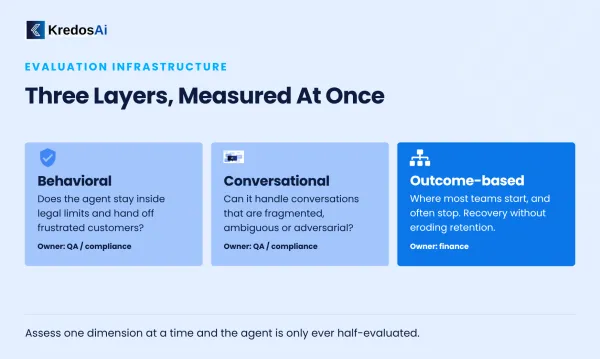
Evaluation infrastructure heavily relies on these three layers:
Behavioral assessment checks whether the agent stays within the anticipated parameters. To ensure that AI plays by the rules, the teams must ask: Is it handing off frustrated customers to human agents? Is it staying inside legal limits? In collections, behavioral failures usually trigger complaints before the issue shows up in recovery metrics.
Conversational assessment considers the quality of the interaction itself. People involved in a collections situation are usually under a great deal of stress. An agent that has been trained on clear and cooperative conversations may have difficulty handling actual interactions, which are fragmented, ambiguous, or adversarial. Even by giving the right answer, AI might ignore the emotional aspect.
Outcome-based assessment is where most teams start, and often stop. A high recovery rate is an obvious indicator of “successful” interactions and reduced churn in the short term; however, if this metric is a result of aggressive or repetitive contact, it may lead to eroding retention over the following billing cycles. In simple terms, a really successful collection is collecting the money without driving the customer to cancel their account tomorrow.
The three layers call for different kinds of data, different timelines, and different responsible parties. Behavioral and dialogue-based assessment is generally the responsibility of QA or compliance, while outcome assessment is the concern of finance. If these departments fail to coordinate, the agent is assessed on only a single dimension at a time. This structural gap in AI quality assurance is one of the main reasons why effectively evaluating AI agents remains an open problem, even when teams take AI quality assurance seriously.
A/B testing and adaptive methods expose different weaknesses in AI agent evaluation
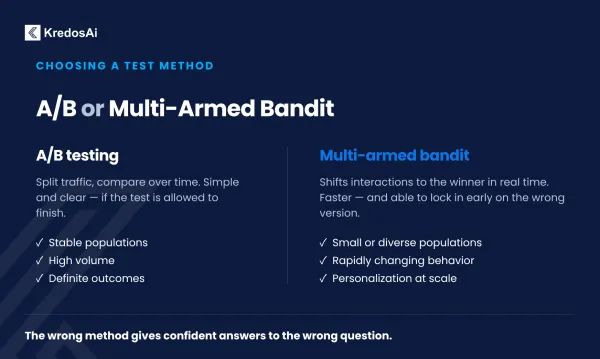
A/B testing and multi-armed bandit (MAB) testing are both used for assessing AI agents, and each one reveals different particularities. The method the team decides to proceed with will define how good the results will be and how quickly action must be taken.
A/B testing entails dividing the traffic between two versions of an agent and then comparing their performance over time; it is simple and clear, but reliable results require discipline. Many teams check the results too early, make adjustments to the test halfway through, or cease the test before there is sufficient data. Teams consider unreliable metrics, and, as a result, most decisions are based on noise rather than on the actual signal.
Multi-armed bandit (MAB) testing works differently. It continuously sends more interactions to better-performing versions in real time, adapting as it learns. MAB is faster, but if early results are misleading, it can lock in on the wrong version before enough data is gathered.
Methods such as MAB are most effective when applied to small, diverse, or rapidly changing populations. In the case of collections, a method that redistributes interactions according to what is working will perform better than a static testing approach. A/B testing is appropriate for situations involving stability and a high volume, whereas MAB is suitable for cases involving variation and speed. Employing the incorrect method will result in inaccurate outcomes.
Teams that delay building AI agent evaluation infrastructure will be fixing live systems under pressure
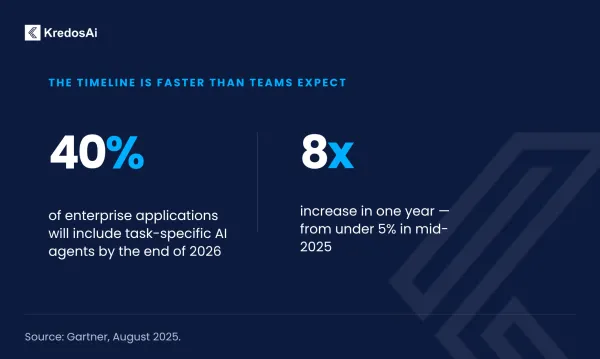
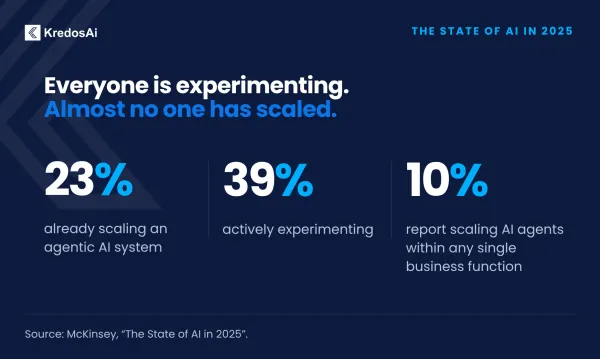
The timeline is faster than most teams expect. Gartner predicted in August 2025 that 40% of enterprise applications will include task-specific AI agents by the end of 2026, up from less than 5% in mid-2025. That is roughly an 8x increase in one year. McKinsey's "The State of AI in 2025" found that 23% of organizations are already scaling an agentic AI system and another 39% are actively experimenting, yet no more than 10% report scaling AI agents within any single business function.
The QA of AI practices goes from a “nice-to-have” feature to the backbone of the entire company. Collections is one of the industries most likely to receive AI agent investment in the near term, given the volume of interactions, the cost pressure on human agents, and the growing complexity of consumer debt. Teams that build assessment infrastructure now will have a meaningful head start. Teams that wait will retrofit AI quality assurance onto systems already making consequential decisions.
Three conditions determine whether AI agent evaluation in collections actually works
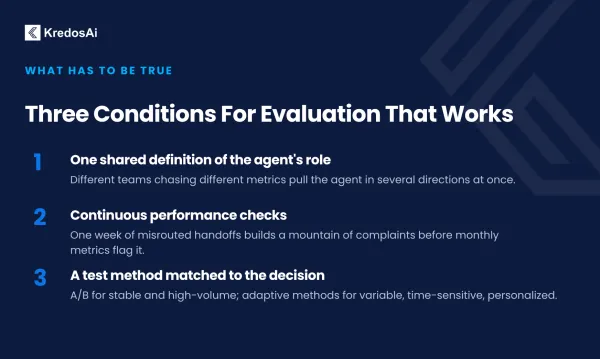
The main signs that AI agent evaluation works:
First of all, it is necessary to establish a common understanding of the agent's role. Recovery rate, complaint rate, escalation rate, and customer retention are all acceptable measures of success. If various parties are focusing on different metrics, then the agent is pulled in several directions and is evaluated according to criteria for which it was not originally designed.
Second, check agent performance constantly. A single week of misrouted handoffs creates a mountain of regulatory complaints long before your monthly metrics flag the issue.
Third, a testing method that is appropriate for the decision in question. A/B testing is well suited to stable, high-volume situations with definite outcomes, on the condition that the test is allowed to run to completion; in contrast, variable, time-sensitive or highly personalised scenarios are more suitable for adaptive methods. Using the incorrect methodology results in confident answers to the wrong questions.
A sustainable hybrid model for QA of AI in collections is replacing one-time deployment checks
The quality model for QA of AI is still being built. What teams have already learned is that old software checks and basic customer service ratings aren't enough on their own. This led to the creation of the hybrid method. This method is sustainable and consists of automated monitoring to ensure behavioral compliance, conversational sampling for the purpose of quality assessment, and tracking of outcomes that link payment events to customers' longer-term behavior. In reality, this combined approach is the way of evaluating AI agents on a large scale. Teams that handle this properly see AI agent evaluation as a continuous process rather than something to be checked at the time of deployment. They create AI quality assurance infrastructure that is reliable even when agents are dealing with hundreds of conversations at the same time.
An AI agent that recovers a payment and keeps the customer is worth more than one that recovers the payment and creates a complaint. Assessment is how you tell the difference.
FAQ
Why can't collectors take advantage of the same AI evaluation methodology as the rest of the enterprise?
Because there is no opportunity to recover from mistakes. If a support ticket gets routed to the wrong team, a follow up message can correct the issue. But if a collections agent sends out the wrong message, or the message at the wrong time, the customer could file a formal complaint and/or cancel their service entirely in response.
What are the three pillars of a comprehensive AI agent evaluation framework in the context of collections?
Behavioral (does the agent operate within regulatory and compliance guidelines), conversational (can the agent manage difficult conversations under pressure), and outcome-based (is the agent able to recover delinquent payments without damaging retention). Evaluation around all three pillars should occur simultaneously.
Now, isn't outcome-based performance evaluation enough?
Not really. High recovery rates can mask negative behaviors by agents that cause cancellations during the next billing cycle. Outcome-based metrics should be considered in conjunction with retention, not as a substitute for them.
A/B-testing or Multi-armed bandit (MAB) testing, which one would you choose for evaluating AI agents?
It depends on the scenario. Testing under stable conditions with high traffic volume favours A/B-testing, while more volatile environments with personalization at scale benefit from MAB's adaptive nature. It's important to note that MABs can create false positives and become too confident about an underperforming variation if not monitored closely.
How quickly is the industry adopting AI agents for collections use cases?
According to Gartner, 40% of enterprise applications are projected to have built-in task-specific AI agents by the end of 2026, compared to less than 5% in mid-2025. With that said, McKinsey's research shows that no more than 10% of companies across any given business line are likely to have effectively scaled AI agents at the time of this writing.
What would be considered a sustainable evaluation model for agents handling collections?
It's going to be a mix of automated behavioral assessments, manual conversation reviews, and outcome analysis that ties delinquency recovery to long-term customer behavior on an ongoing basis, not a one-time setup.