

- Blog
- How to cut auto loan delinquency before a borrower hits 30…
How to cut auto loan delinquency before a borrower hits 30 days late
Stop Auto Loan Delinquency Before Day 30: 4 Signals That Predict a Missed Payment
by Brian Terr, Founder and President of Auto Recast Services

Brian Terr is Founder and President of Auto Recast Services, which works on the debt finance side of the automotive industry. He previously founded Inventory Command Center, acquired by J.D. Power, and was VP of National Accounts and Business Development at Edmunds.com. He has spent 25 years in the automotive industry.
When it comes to car affordability, most conversations end as soon as the buyer leaves the dealership. The challenge often begins to appear well after the initial transaction. What might happen a year later, when grocery prices have climbed, work hours have been reduced, or credit card balances have started to spiral? Can the same person still keep up with their car payments then?
It’s important to understand that nobody made a mistake when they signed the papers. But life circumstances change, and the loan that was pretty manageable in March can suddenly become a real burden by November.
Record payments leave no room for a short paycheck
The average new vehicle sold for $50,090 in August 2026, with a monthly payment of $770 at 9.49%, according to the Cox Automotive/Moody's Analytics Vehicle Affordability Index. The index also measures affordability in weeks of work: the average buyer now needs 35.5 weeks of median income to cover the price of that vehicle. Two-thirds of a year's earnings for one car.
A large share of buyers start out owing more than the car is worth. Edmunds found that 29.6% of trade-ins in Q2 2026 were underwater, with an average negative equity of $6,884. That negative equity gets rolled into the new loan, so the borrower finances a portion of the old car and the new one at the same time. Their average payment is $944 per month, compared with the industry average of $777.
At $944 a month, one missed paycheck is enough to push an account 30 days past due. The borrower doesn't have to lose a job. A week of cut hours, a delayed commission, or a medical bill landing in the wrong week will do it.
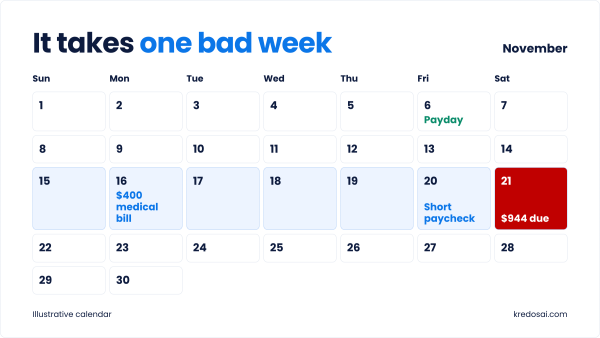
And $944 isn't the top end. A loaded pickup can cost over $1,000 a month, and 20.3% of new-car buyers signed up for payments of that size in Q2 2026. That's one in five people driving off the lot with a four-figure monthly bill.
Now look at what people have saved. Only 63% of adults could cover a $400 surprise expense in cash. So more than a third of American adults would have to borrow or skip something to handle a $400 problem. A $944 payment and $400 in the bank can't both survive the same bad week.
When a borrower suddenly can’t afford a payment they once managed, it quickly becomes the lender’s problem as well, since the bank or investor now holds a loan that isn’t generating the expected payments.
Every dollar spent before day 30 is worth more than a dollar spent after
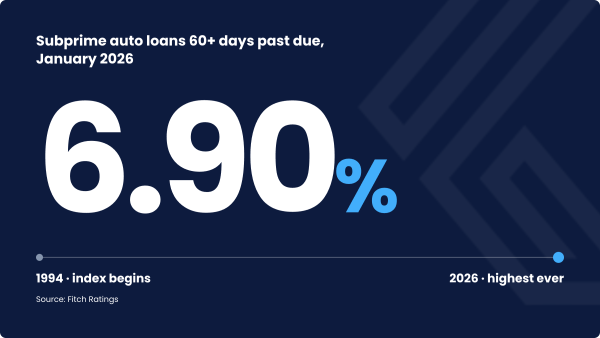
Subprime borrowers are falling behind at the highest rate in about 30 years. Fitch Ratings tracks the percentage of subprime auto loans that are 60 or more days past due, and that figure hit a record 6.90% in January 2026. The index dates back to 1994 and has never been higher.
Even superprime borrowers, the customers with the best credit and the lowest rates, now face auto loan defaults at roughly twice the rate they did through most of the years after the last recession.
The vehicle sells at auction for around 60% of its value, so the lender loses money on the car itself. Towing, storage, and auction fees are deducted from what's left.
Add all of that up, and the gap between what the borrower was scheduled to pay over the life of the loan and what the lender actually nets at auction can reach $30,000 on a single vehicle. At any moment, somewhere between 4 and 5 million vehicles in the US market are heading toward that ending.
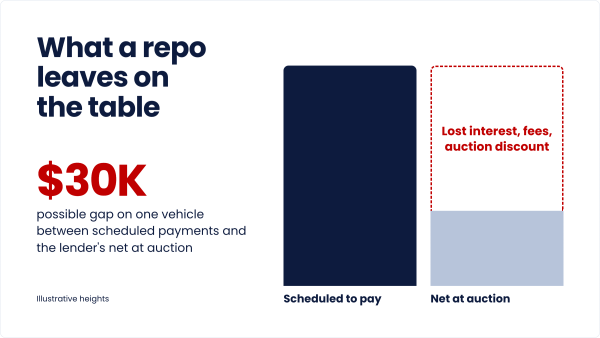
The interest income the loan was supposed to earn disappears entirely. A borrower searching for how to avoid repossession and a lender trying to prevent one want the same thing, which is why early contact beats late pressure.
“The last thing you want to do is take back that vehicle.” - Brian Terr
The whole cost sits on the far side of day 30.
Borrowers have already chosen which bill to skip
A borrower under pressure may behave like an ostrich. Head in the sand, hoping something changes. What they're actually doing is robbing Peter to pay Paul, moving money between a credit card, rent, and groceries, with the car payment as one claim among several competing for the same shrinking budget.
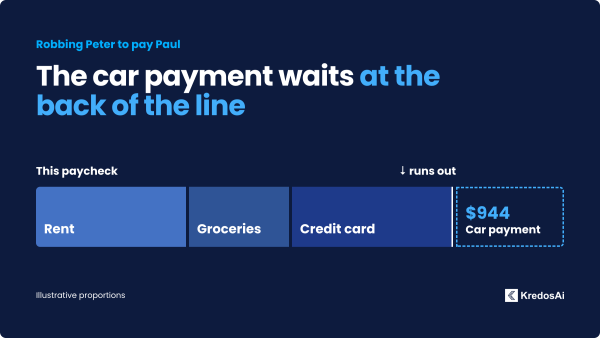
The timing is what matters. By the time a payment is missed, the decision has already been made. A lender whose first contact is a past-due notice is arguing with a choice made a week earlier, which is a much harder conversation than shaping it beforehand. The same ranking behavior turns up among past-due customers in every other billing category.
Four signals flag a missed car payment before it happens
Four things in a borrower's own account history predict risk ahead of the due date. Each points to a different problem, so each calls for a different response.
-
A short or partial payment last cycle. The borrower is prioritizing. A timing fix usually works.
-
A broken promise to pay. The strongest single predictor that this cycle slips too.
-
Silence. No open, click, or reply to recent outreach. Usually avoidance, sometimes friction in the channel.
-
A login without a payment. Intent without completion, which points to checkout friction or an amount the borrower can't cover today.
Across KredosAi deployments, payments arrive 3 to 5 days sooner when outreach is timed to these signals instead of a fixed calendar.
One clear option cures more accounts than a menu of ten
Delinquency management comes down to three levers that work in sequence. Collections messaging carries the first one.
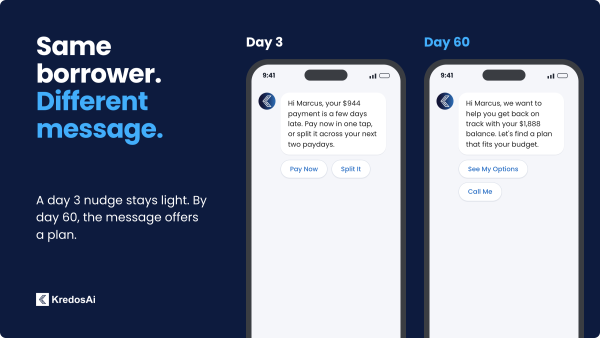
The first is the right message at the right time, varied by stage across 1 to 30 days, 60, 90, and default. What resonates at day 3 is not what resonates at day 60.
The second is a flexible payment option. Splitting a payment between mid-month and month-end aligns with how people actually get paid and costs the lender nothing structurally.
The third is a loan modification, which comes later when default is already likely to occur. Current loan modifications typically provide a near-term fix but do not cure the broader payment problem the consumer is facing. For a modification to be truly effective, it must change the paradigm of the payment structure. For banks that hold loans on their own balance sheet, a modification is straightforward. When loans are pooled into a capital markets structure (ABS), modifications can get a bit more complicated.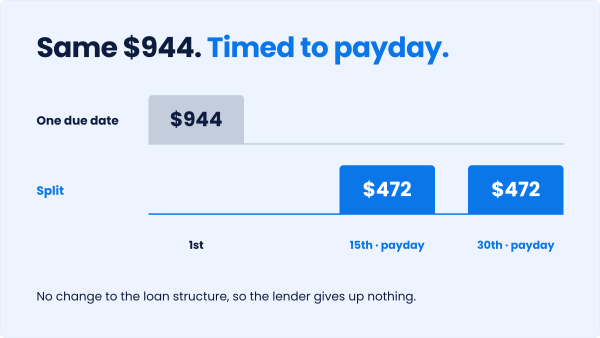
What a borrower needs is an option most likely to suit them, and a system that looks at their past behavior, which can show the lender which of the options is a reminder, a split payment, or a modification.
That variability in messaging is what a multi-armed bandit actually does. The engine keeps testing the message, timing, channel, and offer, converging on what cures this particular borrower, rather than waiting months for a conventional test to reach significance.
The engagement timeline runs from day −5 to day +30
The sequence isn't fixed, which is what separates this from conventional auto loan collections.
Keeping an account current costs less than curing it
Payments near record highs leave borrowers less room for error, and the cost of a roll is measured in thousands of dollars rather than collection minutes. The lenders keeping auto loan delinquency down work smarter, not harder. They reach each borrower with one clear option while the decision is still open.
Repossession prevention is the point all along. A better repossession process was never the goal.
FAQ
How soon does behavior-based outreach show results?
Faster than a conventional test cycle, which is the point of continuous optimization. A multi-armed bandit adjusts within days, rather than waiting for a fixed test window to reach statistical significance, so a lender sees a directional signal within the first billing cycle.
Why is the pre-due-date window more valuable than day 30?
Borrowers decide which bills to pay before the due date arrives. Contact made after the miss argues with a decision already taken, while contact at day −5 still shapes it. Effort spent before day 30 prevents loss instead of managing it.
Does behavior-based outreach mean fewer collectors?
It changes what the team spends time on. Judgment calls like risk tolerance and hardship recognition stay with people. High-volume, repetitive contacts are routed to software, which is how ABB absorbed the volume without adding offshore headcount.
How is this different from automating an existing dunning schedule?
A dunning schedule sends the same sequence to every account regardless of behavior. Behavior-based outreach changes the message, timing, channel, and offer for each borrower and updates as new signals arrive. Automating a fixed schedule enables the same decisions to be made faster.