KredosAi was founded in 2021 by Balaji Sridharan and Dave Thoms, both former T-Mobile executives who built the company after experiencing the delinquency problem from inside a Tier 1 operator. It uses a Multi-Armed Bandit (MAB) machine-learning algorithm, customized for collections, to optimize digital engagement across telecom, auto lending, and financial services. MAB is a method that runs multiple message/channel/timing options simultaneously and continuously shifts traffic toward whichever performs best in real time.
TrueAccord was founded in 2013 in San Francisco by Ohad Samet (CEO) and Nadav Samet (Co-Founder), after Samet's own experience of being pursued by collectors over an unpaid store-card balance. TrueAccord is now headquartered in Lenexa, Kansas, under parent company TrueML Technologies (formerly One True Holding Company). Mark Ravanesi has served as TrueAccord's CEO since August 2021. Its outreach is powered by HeartBeat, TrueAccord's patented machine-learning engine, which sends messages via email, SMS, automated voicemail drops, and Facebook Messenger. HeartBeat's name and underlying patents belong to TrueAccord, not to any third party.
Quick Comparison: KredosAi vs. TrueAccord
| Category |
KredosAi |
TrueAccord |
| Founded |
2021, Issaquah, WA |
2013, San Francisco, CA (HQ now Lenexa, KS) |
| Founder / CEO |
Balaji Sridharan (CEO), Dave Thoms; former T-Mobile executives |
Ohad Samet & Nadav Samet (co-founders); Mark Ravanesi is CEO of the TrueAccord subsidiary since 2021; Ohad Samet is CEO of parent TrueML Technologies |
| Core AI approach |
MAB reinforcement learning + GenAI messaging; agentic AI and voice agents approaching release |
HeartBeat: patented ML engine that tests and learns from consumer interactions to optimize timing, channel, and content. Specific ML architecture (e.g. whether it uses reinforcement learning): Not publicly stated beyond marketing-level description. |
| Business model |
Software: optimization engine licensed into the client's own collections operation |
Service: licensed collection agency; accounts are placed with TrueAccord, which collects on the client's behalf (third-party) and, since 2025, also offers first-party pre-charge-off outreach |
| Primary verticals |
Telecom, Auto Finance, Financial Services |
Fintech, e-commerce, BNPL, telecommunications, and credit unions (per TrueAccord's own named case studies and client list) |
| Published ROI |
20–25x at a Fortune 50 US telco (100M+ subscribers) |
No single ROI multiple published. Case-specific liquidation lift of 25–35% over traditional call-and-collect, reported per client engagement |
| Supporting metrics |
12.5% cure rate improvement; 7.4% suspend reduction |
96% of consumers resolve without speaking to a human agent; three named 2024 telco pilots saw liquidation increases of 35%, 7%, and 32% respectively |
| Customers |
Fortune 50 US telco, Anderson Brothers Bank |
Named case studies: Upwork, Snap Finance, Klarna; unnamed clients in telecom |
| Compliance certification |
SOC 2 Type 2 |
ISO 27001 (data centers), PCI-DSS, and Reg E, per TrueAccord's own security page. SOC 2 Type 2: not publicly stated on TrueAccord's own site (see Compliance section) |
| Voice / IVA |
Native voice agent approaching release |
No live AI voice agent confirmed; “voicemail drops” (automated, pre-recorded) confirmed on TrueAccord's own product page |
| Embedded payments |
No |
Self-serve web portal for payment plans and settlements confirmed; specific payment methods (e.g. Apple Pay/Google Pay): Not publicly stated |
| RCS |
Yes |
Not publicly stated. |
| Pricing model |
Flexible: performance-based and SaaS; no-cost pilot |
Not publicly stated. |
| Latest disclosed move |
$7M Series A (July 2026); multi-agent framework approaching release |
Acquisition of Sentry Credit (May 2025), adding first-party and litigation collection capacity. No funding round found after June 2022. |
AI Methodology: MAB Reinforcement Learning vs. HeartBeat ML
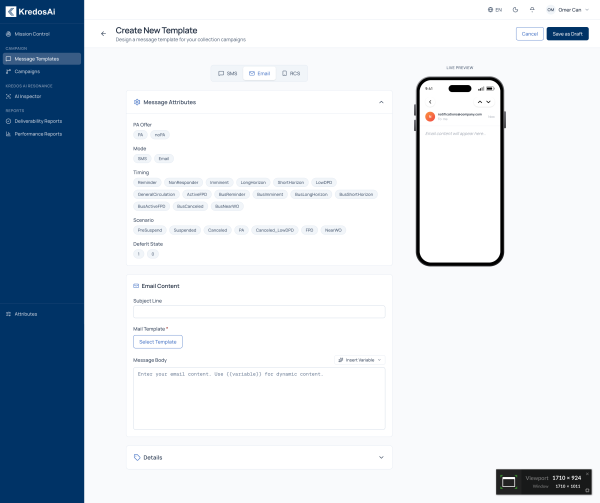
Both vendors describe themselves as AI-driven. The difference worth checking isn't which one sounds more sophisticated; it's which claims are specific enough to verify. KredosAi names a mechanism: Multi-Armed Bandit is an explicit exploration/exploitation trade-off that reallocates traffic toward winning message/channel/timing combinations as evidence accumulates, and a buyer can ask to see that reallocation on a live account. TrueAccord names outcomes, testing, learning, and optimizing without publishing the mechanism that produces them.
| KredosAi: MAB Reinforcement Learning |
TrueAccord: HeartBeat ML Engine |
|
For each delinquent account, the KredosAi engine:
1. Chooses the message variant, channel (SMS, RCS, email), and send time most likely to cure the account.
2. Updates continuously based on actual resolution outcomes.
3. Deploys Agentic AI capabilities, meaning the system can complete a multi-step task end-to-end (for example, negotiating and confirming a payment plan from a reply) without a human or a separate system handling the next step. This is a functional step beyond decisioning ML, which selects the next message but does not act on what comes back.
TCPA/FDCPA guardrails and human-in-the-loop review sit in the messaging layer, per KredosAi's own materials.
|
TrueAccord's own site describes HeartBeat as a “patented machine learning platform” that:
1. Continuously tests and learns from consumer interactions.
2. Optimizes the next-best touchpoint (timing, channel, content) per consumer in real time.
3. Detects consumers at risk of breaking a payment plan and adapts outreach to keep them on track.
The underlying ML method, whether reinforcement learning, a rules-based engine, or something else, is not publicly stated beyond this marketing-level description in any source.
|
Business Model: Optimization Software vs. Collection Agency
KredosAi sells software. An enterprise licenses the platform and integrates it via API against its own systems; the client keeps ownership of the account and the compliance program throughout.
TrueAccord is a licensed collection agency, confirmed via NYC DCA, California, and Nevada collection-agency licenses. Its own site states it “does not purchase debts nor does it own your debt.” Clients place accounts with TrueAccord, and TrueAccord collects on their behalf under its own brand and licenses.
For a procurement team, the practical question isn't just “which platform performs better.” It's “do we want to keep collections in-house and add a decisioning layer, or hand the accounts to a licensed servicer.” These are different purchase decisions, even when a sales conversation frames them as competing options.
ROI and Documented Outcomes
| KredosAi: 20–25x ROI at Fortune 50 Scale |
TrueAccord: Case-Specific Liquidation Lift |
|
KredosAi's own published outcomes, from a Fortune 50 US telco deployment (100M+ subscribers):
• 12.5% cure rate improvement
• 7.4% reduction in subscriber suspensions
• 20–25x ROI attributed to this engagement
KredosAi offers a no-cost pilot so buyers can validate figures against their own data before committing.
|
TrueAccord does not publish a single headline ROI multiple. Its own blog and case-study pages report engagement-specific results:
• 25–35% higher liquidation vs. traditional call-and-collect, reported per client
• 96% of consumers resolve without speaking to a human agent
• A fintech client recovered $500,000 within 9 months with 95% self-serve engagement
|
Vertical Fit
| Vertical |
KredosAi |
TrueAccord |
| Telecom |
Core vertical; Fortune 50 US telco client at Tier 1 scale |
Named 2024 case study: three US telecom providers, six-month pilot, all three later moved fully onto TrueAccord's platform |
| Financial Services / Banks |
Active; Anderson Brothers Bank named |
Unnamed National Bank pilot, using a Champion-Challenger model. |
| Auto Finance |
Active expansion; Series A explicitly funds auto lending |
Not named in any TrueAccord case study or client list reviewed |
| Fintech / E-commerce / BNPL |
Not a stated vertical |
Core vertical |
| Credit Unions |
Not publicly stated |
Named as a client industry on TrueAccord's own press materials; no specific named credit-union client found |
Compliance and Security
| Category |
KredosAi |
TrueAccord |
| Certification |
SOC 2 Type 2 |
Not publicly stated on TrueAccord's own compliance/security pages. |
| Data center certification |
Enterprise AWS |
ISO 27001 certified data centers, per TrueAccord's own Information & IT Security page |
| Payment security |
No embedded payments |
PCI-DSS compliant payment processors, per TrueAccord's own site |
| Additional certifications |
Not publicly stated |
Regulation E compliant, per TrueAccord's own site |
| FDCPA/Reg F approach |
Built into the AI optimization engine; human-in-the-loop review in the messaging layer |
“Legal-driven coded compliance,” TrueAccord's own description |
| Encryption |
Not publicly stated |
TLS in transit; AES-256 at rest, per TrueAccord's own site |
| State/local licensing |
Not publicly stated in detail |
Confirmed licenses: California (10526-99); Nevada (CAD11758, Compliance Manager CM12939); New York City DCA (#2086769-DCA) |
| Known regulatory action |
No reports |
Jan. 16, 2024: Assurance of Discontinuance with the Colorado Attorney General's office over collection on ~29,000 tribal-lender accounts (2017–2022) carrying 500–900% APR, exceeding Colorado's 12% cap for unlicensed lenders. TrueAccord paid $500,000 for consumer restitution and denied violating Colorado law as part of the settlement. TrueAccord states it had already stopped collecting on these accounts in June 2022. |
Integration
One channel worth defining first: RCS (Rich Communication Services) is the carrier-backed successor to SMS. It adds a verified business sender, images, and interactive buttons directly inside a consumer's native texting app.
| Category |
KredosAi |
TrueAccord |
| Integration model |
API-first; BSS/OSS and core banking data ingestion into the client's own systems |
Public API documentation available, account placement/file-transfer model typical of collection agencies; named partnership: |
| Channels (confirmed) |
SMS, RCS, email |
Email, SMS, automated voicemail drops, and Facebook Messenger |
| Voice |
Native voice agent approaching release |
No live AI voice agent confirmed; automated voicemail drops only |
| RCS |
Yes |
Not publicly stated |
| Notable named integrations/partnerships |
FICO Platform partner |
Synapse (BaaS partnership, 2022); Sentry Credit (acquired) |
Pricing
| Model |
KredosAi |
TrueAccord |
| Structure |
Flexible: performance-based and SaaS licensing |
Not publicly stated on TrueAccord's own site. |
| Pre-commit validation |
No-cost pilot measuring cure rate, write-off, and CX before commitment |
Not public |
| What you're buying |
A decisioning layer your team operates |
A servicing outcome TrueAccord delivers on your behalf, as the collector of record for placed accounts |
| Rate detail |
Custom; contact sales |
Custom; contact sales |
Vendor Background
| Category |
KredosAi |
TrueAccord |
| Founded |
2021 |
2013 |
| HQ |
Issaquah, Washington |
Lenexa, Kansas, is consistently confirmed via NYC DCA licensing, BBB, and the Lenexa Chamber of Commerce. Originally founded in San Francisco, CA. |
| Founders / Leadership |
Balaji Sridharan (CEO) and Dave Thoms (Co-Founder), both former T-Mobile executives |
Ohad Samet and Nadav Samet (co-founders); Mark Ravanesi is CEO of the TrueAccord subsidiary (since Aug. 2021); Ohad Samet is CEO of parent company TrueML Technologies |
| Total funding |
Just over $10M (KredosAi's own disclosure) |
No single authoritative total confirmed. Individually sourced rounds range from a $250K 2014 Series A to a ~$49M 2022 round. |
| Scale / revenue |
6x revenue growth over two years |
Not company-disclosed or audited. |
| Corporate structure |
Independent company; SOC 2 Type 2; FICO Platform partner |
Subsidiary of TrueML Technologies (formerly One True Holding Company) |
| Roadmap |
Multi-agent framework; voice; auto lending and FS expansion |
Integrating Sentry Credit's first-party/litigation capabilities; continued fintech/BNPL/telecom focus per named case studies |
Which Platform Is Right for Your Organization
Choose KredosAi if:
-
You want to keep collections in-house and add a real-time optimization layer on top of your own outreach.
-
Cure rate, suspend reduction, and a documented ROI multiple, measured on accounts you still own, are your primary KPIs.
-
SOC 2 Type 2 and built-in TCPA/FDCPA guardrails are hard procurement requirements you need confirmed and documented.
-
You want pilot data on your own accounts before committing.
-
RCS and an eventual native voice agent are part of your channel roadmap.
Choose TrueAccord if:
-
You want to assign delinquent accounts to a licensed specialist rather than handle the outreach yourself.
-
Fintech, e-commerce, or BNPL is your primary vertical, where TrueAccord has named, verifiable case studies.
-
You need both third-party (post-charge-off) and, since the Sentry Credit acquisition, first-party (pre-charge-off) collection capacity from one vendor.
-
A self-serve consumer payment portal with minimal live-agent involvement fits your brand and cost goals.
-
You are comfortable running your own compliance diligence on items TrueAccord does not publish before signing.
Frequently Asked Questions
What is the difference between KredosAi and TrueAccord?
KredosAi is a software platform that a company licenses and runs against its own delinquent accounts. TrueAccord is a licensed collection agency that accounts are placed with, and which collects on the client's behalf using its own HeartBeat machine learning engine.
Does TrueAccord support RCS messaging?
TrueAccord does not publicly state support for RCS (Rich Communication Services), the interactive, media-rich successor to SMS. TrueAccord's own product pages list its channels as email, SMS, automated voicemail drops, and Facebook Messenger, with no mention of RCS anywhere reviewed. KredosAi supports RCS today.
What pricing model does TrueAccord use?
TrueAccord does not state its own pricing model anywhere on its site. Its blog explains the three standard debt-collection-industry structures (flat fee, contingency, and hybrid) as general education for any buyer evaluating a collection agency, but never specifies which one TrueAccord itself uses. Confirm this directly during procurement.
Has TrueAccord had any regulatory or legal actions?
Yes. TrueAccord settled with the Colorado Attorney General's office on January 16, 2024, over debt it collected on tribal-lender loans. Colorado's investigation found that between 2017 and 2022, TrueAccord collected or attempted to collect from roughly 29,000 consumers on these loans. Interest rates ran from about 500% to 900% APR, far above the state's 12% cap for unlicensed lenders. TrueAccord paid $500,000 for consumer restitution and denied violating Colorado law as part of the settlement. It also stated it had already stopped collecting on the affected accounts in June 2022. Secondary consumer-legal sources separately describe private FDCPA (Fair Debt Collection Practices Act) class-action lawsuits against TrueAccord over the years; those were not independently verified against court dockets in this research and carry lower confidence.
Which vendor has documented enterprise telecom results?
Both vendors publish enterprise telecom results at different scales and levels of specificity. KredosAi's published outcome is a single Fortune 50 US telco with 100M+ subscribers, with a specific 20–25x ROI figure and cure-rate/suspend metrics. TrueAccord's telecom evidence is a 2024 six-month pilot across three unnamed US telecom providers, with liquidation increases of 35%, 7%, and 32%, respectively, after which all three moved fully onto TrueAccord's platform. Ask each vendor for the client scale and measurement period behind their figures before comparing them directly.
Should we build an in-house collections optimization engine instead of buying either?
Usually not. The true cost is higher than it looks on paper. In-house builds come up in most enterprise RFPs, and the appeal is real: model control, no licensing cost, proprietary data integration. What typically gets underestimated is the annual cost of ML engineering talent and ongoing compliant multi-channel infrastructure, which often exceeds a purpose-built optimization engine's licensing fee. It also doesn't address the separate question of whether you want to service accounts yourself at all. See KredosAi's own build-vs-buy breakdown for the specific cost categories, and KredosAi's no-cost pilot is designed to make this comparison concrete with real data rather than projections.