

- Blog
- RCS in messages solves the identity problem in payment…
RCS & Messaging
RCS in messages solves the identity problem in payment reminders
Where RCS beats SMS for payment reminders, and where SMS still wins.
by Scott Nadzan

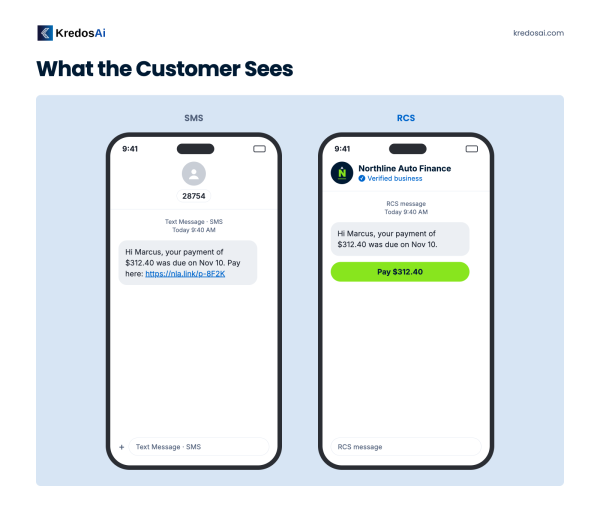
A collections team sends a payment reminder. It arrives from a five-digit number the customer has never seen, with no brand name attached, asking for money and containing a link.
The customer does not tap it. Their bank and their carrier have both told them not to. From where they are sitting, that message is indistinguishable from fraud. Sending it twice more does not help, because the customer still cannot tell who is asking.
RCS in messages was built for exactly that gap. It puts the lender’s name, logo, and a verified checkmark on the message, inside the app the customer already uses every day, so the question of who is asking gets answered before they decide whether to read on.
What is RCS business messaging?
RCS (Rich Communication Services) is a carrier-standard upgrade to SMS that runs inside the phone’s default messaging app. For businesses, it adds a verified sender with brand name and logo, rich cards and buttons, two-way conversation, and delivery and read receipts.
The question that follows is how much that identity fix is actually worth, and where SMS still does the job better.
Payment texts get ignored because they look like the scams people are warned about
Consumers reported losing $470 million to text-message scams in 2024, more than five times the 2020 figure. Bank impersonation was the most-reported text scam type.
That is the environment every payment reminder now arrives in. A customer receiving an unidentified message about money has learned to treat it as a threat, and they have been trained to ignore it.
A plain payment text usually fails because the recipient cannot identify the sender, and sending the same message more often doesn't answer that question. Verified sender identity does, which is the first thing RCS adds and the specific problem it addresses. The wider move toward digital collections runs on the same reasoning.
RCS is already the format Americans use every day
More than one billion RCS messages are sent every day in the US, based on a 28-day average, according to Google. That figure covers all RCS traffic, personal conversations included, so it describes adoption of the format rather than business message volume.
Recognition is what makes that number useful to a collections team. Customers already use RCS with friends and family, so a verified business message in the same app reads as ordinary rather than unfamiliar. A channel nobody recognizes has to earn trust before it can carry a payment request.
RCS wins on identity, SMS wins on reach
Most channel comparisons score features. A collections team chooses on different criteria, so the table below scores what the decision actually turns on, including limits.
SMS reports nothing between send and reply, so a message that was never seen and a customer who is deliberately ignoring you look identical. RCS separates those two, and they call for different next steps. A customer who has not opened anything needs a different channel. A customer who opens and does not act needs a different offer. That distinction matters most in the mid stages, where the psychological economy of DPD 60 shifts what someone is willing to open at all.
RCS fixes identity and friction, and the rest stays your job
Two of those rows are where channel upgrades most often disappoint. A customer who cannot cover the balance will not pay because the message looked better, and a well-designed message arriving at the wrong point in the cycle is still arriving at the wrong point. Evaluating that distinction is part of choosing any tool, which debt collection software in 2026 works through in more detail.
Compliance rules apply to RCS exactly as they do to SMS
Nothing in the regulatory picture changes with the channel:
- Consent requirements apply as they do to SMS.
- Contact frequency limits apply.
- Time-of-day restrictions apply.
- Required disclosures apply.
- Opt-out handling applies.
Two things do change, both in the lender’s favor:
- The verified sender reduces impersonation risk against your own brand.
- Delivery and read receipts produce a cleaner audit trail.
One caution runs the other way. Richer formatting makes it easier to accidentally imply a consequence or an offer that is not accurate for that account. A button labeled “Set up my plan” is a commitment to a plan that the customer may not be eligible for. Reviewing the message is even more crucial than reviewing the channel.
Channel is an output of the treatment decision
Any outreach involves five decisions: who to contact, when, on which channel, with what message, and with what offer. Naming RCS as the house channel replaces one fixed rule with a different fixed rule, which is why the lift from a channel upgrade alone tends to fade.
The version that moves payments is decided per account. One customer responds on RCS. Another only ever replies to email, and should not be sent anything this week regardless.
KredosAi runs branded, verified RCS alongside SMS, email, and voice, selecting per account rather than per campaign. Where a customer’s device, carrier or history makes RCS the wrong choice, the fallback is a decision rather than an accident. The platform sits on top of a collections management system instead of replacing it, so the system of record and the compliance controls stay where they are.
Across KredosAi deployments, engagement runs at 43% on RCS against 25% on SMS and 15% on email. These are KredosAi platform figures measured on live past-due accounts rather than industry averages.
The question is whether the customer can tell who sent it
Channel choice in collections rarely turns on which technology is newest. It turns on whether the person receiving the message can identify the sender and see what to do next. RCS answers the first clearly and helps with the second, and leaves everything else to the strategy behind it.
FAQ
What is RCS in messaging?
A carrier-standard upgrade to SMS that runs in the phone’s default messaging app, adding verified business senders, images and buttons, two-way chat, and read receipts. It works over data rather than the cellular text network.
What is RCS business messaging?
The business-facing version, where a verified brand sends branded, interactive messages to customers in the same app they use for personal texts.
How widely is RCS used?
More than a billion RCS messages are sent daily in the US, on a 28-day average, according to Google.
Is RCS better than SMS for payment reminders?
For reach, SMS still wins. For identity, two-way conversation, and completion, RCS does. Most books need both, with SMS as a designed fallback.
What is text to pay?
Sending a customer a message with a secure link or button to settle a balance, without a portal login or a phone call. Pay by text describes the same thing from the customer’s side.
Does using RCS change collections compliance obligations?
No. Consent, frequency, timing, and disclosure rules apply as they do to SMS.